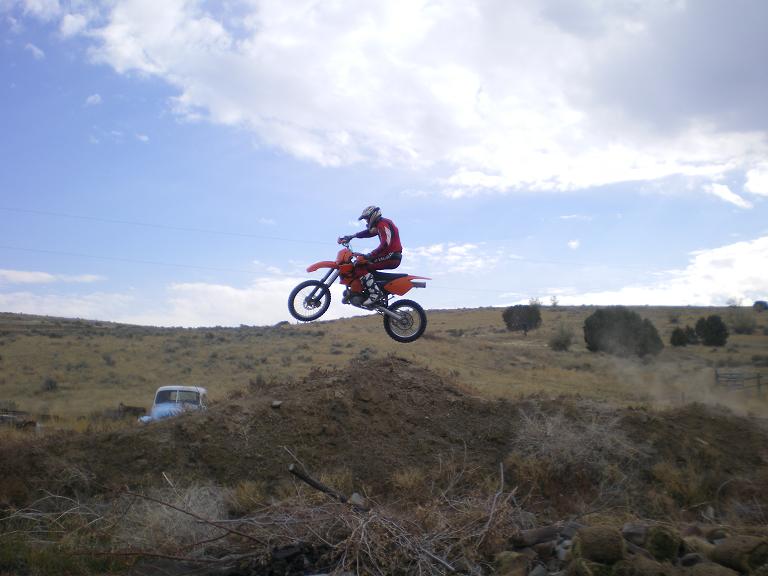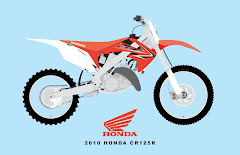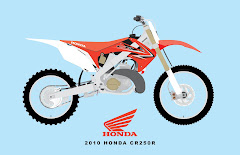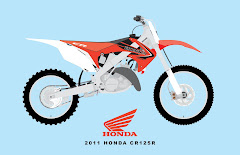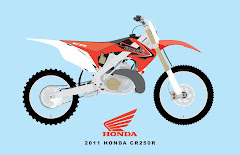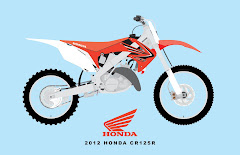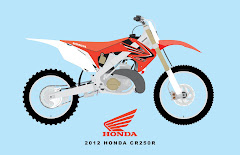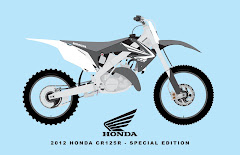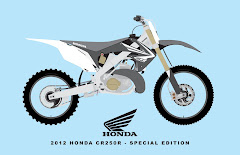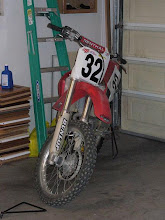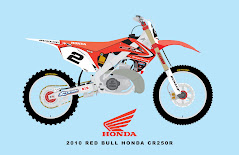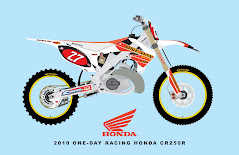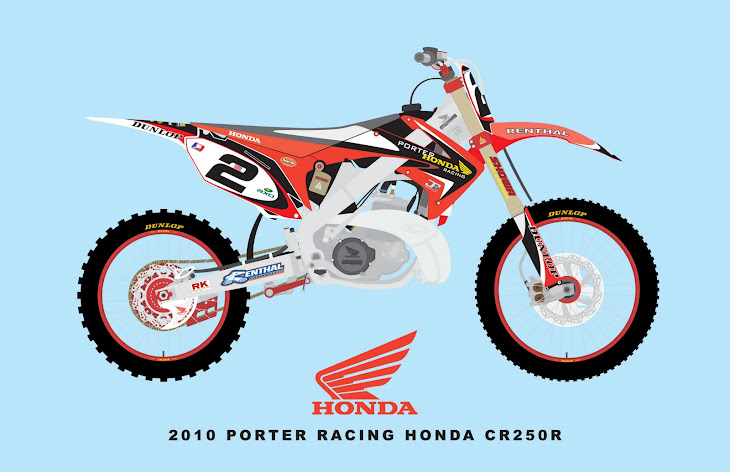
2010 PORTER RACING HONDA CR250R

2010 PORTER RACING HONDA CR250R

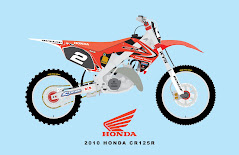
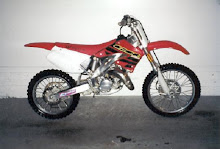
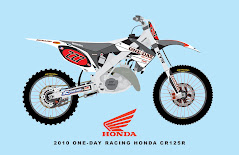
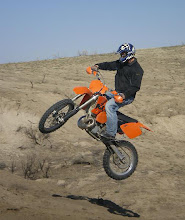
2000 HONDA CR125R

2000 HONDA CR125R

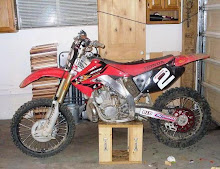
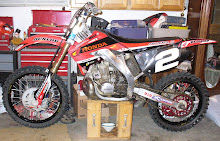
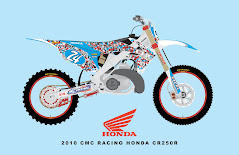
2004 HONDA CR250R

2004 HONDA CR250R

Tuesday, March 9, 2010

FMF's Two-Stroke Dedication

Flying Machine Factory, known as FMF, is dedicated to keeping two-strokes on the tracks and in the hills of the world. Since its start in 1973 FMF has set itself apart as a leading manufacturer of motorcycle and ATV exhausts and accessories.

FMF started when two-strokes ruled the motocross world, and despite the dramatic market change to four-strokes it continues to produce performance two-stroke parts.

Take a look at FMF's 2010 parts catalog to get a full view of their quality products. Here's just a little bit of what FMF has to say about two-strokes:

"If you're already a dedicated gas mixer and are looking to get even more bang for our buck, here are five ways to get more efficient performance out of your 2-stroke program without breaking the bank.:

"1. SKIP THE EXOTIC MOTOR MODS - In the search for more power, many 2-stroke owners will go to the ends of the earth (not to mention the ends of their credit limit) to pump up the performance of their machines. . .

"2. ARMOR UP - If you regularly ride on rocky or rugged terrain, chances are pretty good that your motorcycle is going to take a beating. . .

"3. QUIET DOWN - Loud silencers annoy people. Annoyed people call the police. The police can write tickets. Tickets cost money. Money pays bills. Do you see the connection?

"4. MAXIMIZE YOUR PONIES - It's a fact that the manufacturers spend outrageous amounts of money when developing new motorcycles in order to ensure that every bit of available power is put to the ground. . ."
"5. KEEP RIDING A 2-STROKE - The 2-stroke versus 4-stroke debate may never be settled, but nobody can deny the fact that 2-strokes are easy to maintain, cheap to fix and a blast to ride. . ."

Monday, March 8, 2010

MXA's Describes Its Choices For the Ten Best Bikes (2000-2010)

This may be old news to you. If it is, please, feel free to skip it. But I'm not writing to you. I'm writing to all those that are still unaware. So if you're wondering what I'm talking about please read on.

Motocross bikes have good and bad characteristics. The flaws are merely results of often good ideas executed in a not-so-good manner. Each of the "Big Five" (Honda, Yamaha, KTM, Kawasaki and Suzuki) bike has its signature characteristics.

Honda motocross bikes with Showa forks tend to sink slightly in the initial part their stroke. This slight sag tends to offset the middle part of their stroke, making it harder than it should be. It also decreases the overall travel of the forks.

Yamaha motocross bikes fluctuate fairly significantly each year. For example, the 2010 YZ450F weighs roughly seven pounds more than the 2009 YZ450F. The added weight is noticeable when lifting the bike, but when riding it's quickly forgotten. This is due to Yamaha's new complex engine setup.

KTM motocross bikes often have an exponential delivery of power. Where they may lack a bit of power in lower rpm's, they continually grow in power until they hit their rev limiter. This exponential power tends to make them seem slower than they are. KTM riders benefit from keeping the throttle open. Just make sure to put your seatbelt on.

Kawasaki motocross bikes are big, comparatively speaking. Their large size doesn't lack in weight, but their power decreases the "heavy" feel. Where they lack in lightness they make up in power, and that power makes a potent machine.

Suzuki has constantly focused on creating a superior handling motocross machine. When tuned correctly the Suzuki bikes will out-turn all the other bikes on the track. There's only one caveat to their handling: get it wrong and it becomes an evil machine.

Motocross Action Magazine analyzed all the bikes from the "Big Five" from 2000-2010, choosing what they consider to be the best bikes from the latest decade. Surprisingly, four of the ten are two-strokes. Read which ones won. Motocross Action Magazine, March 2010 issue, pg. 46, "Ten Best Bikes of the Decade." Just flip to the glossary and click on the article.

Friday, March 5, 2010

MXA's KTM 300SX Big-Bore Bike

There's no way around the fact that two-strokes are becoming more rare, harder to find and increasingly obscure in the motocross world. It's a crying shame that so many kids don't get to experience what I call the "fun factor," namely hard-hitting two-stroke power.

Some freestyle motocrossers still recognize the advantageous power-to-weight ratio found in modern two-strokes. Considering the average stock 250cc two-stroke made in the last ten years has roughly 45 horsepower and only weighs about as much as a 250cc four-stroke. That's like having the same bike, only with seven or eight more horsepower.

Now, imagine taking a 250cc two-stroke and increasing its displacement by 50cc's. That's what MXA does to their KTM 250SX. Check it out to learn more. Motocross Action Magazine, April 2010 issue, pg. 164. Just flip to the glossary and click on the article "We Build a KTM 300SX Big Bore."

Thursday, March 4, 2010

MXA's Reasons "Why the Two-Stroke Isn't Dead"

You should know the market trends if you've set foot in a motorcycle shop at any point in the last ten years. Ten years ago the only four-stroke motocross bike in production by any of the "Big Five" (Honda, Yamaha, KTM, Suzuki and Kawasaki) was the Yamaha YZ426F.

The YZ426F was an updated YZ400F, which was Yamaha's production version of the historical YZM400 bike that Doug Henry road to win the 1998 AMA Motocross Championship, the first time for anyone on a four-stroke. Henry also was the first ever to win a U.S. Supercross race on a four-stroke in the 1997 Las Vegas AMA Supercross.

Without any more history lessons, it's apparent that four-strokes are outselling and outperforming two-strokes. This is especially obvious by the mere fact that only two of the "Big Five" still even produce two-strokes - Yamaha and KTM.

MXA points an accusing finger at the people that caused the dramatic dwindling of two-strokes: "We have met the enemy and he is us." Check out the article in Motocross Action Magazine, December 2008 issue, pg. 126. Just flip to the glossary and click on the article, "Why the Two-Stroke Isn't Dead."

Wednesday, March 3, 2010

Top-end Rebuild and Lunch for $200

Perhaps the incessant battle between two-strokes and four-strokes will never really end. There are die-hards on both sides of the issue, but should it really be an issue? I keep asking myself that question.

For me, I know I like the simplicity of two-stroke motocross bikes. Once every couple years I can spend several hours working on my 2004 Honda CR250R motorcycle and have it running perfectly after a top-end rebuild (I haven't ever raced, hence the "every couple years") and minor jetting adjustments. And a small stack of ten Jacksons ($200) gets me a new Wiseco piston kit and Cometic gasket set, two quarts of coolant (I use Pro Honda HP premix coolant), and I can still have enough money for a few five-dollar footlongs from Subway.

I typically do my parts shopping online, consistently visiting my trusty online suppliers, Rocky Mountain ATV/MC and Motorcycle Superstore. Between these two companies I can find what I need and want for reasonable prices. Rocky Mountain ATV/MC will even send a discount code with each electronic invoice for 10% off my next purchase within 30 days. Who could complain about that? Plus, Rocky Mountain ATV/MC is from my home state of Utah, which makes for quick shipping.

Perhaps my choice of machine makes me sound unwise, ignorant or even foolish. That's okay with me. I know the strengths of my bike and its weaknesses. Furthermore, I know my own strengths and weaknesses. Knowing these strengths and weaknesses helps me set my biking boundaries, and I'm comfortable that way.

My budget is tight, especially now that I'm married and going to school. I couldn't handle the steep cost of repairs tied into a four-stroke motocross bike. Granted, they may not need work as often as a two-stroke, but when they do need work it's a hefty financial endeavor. Not to mention their increased number of parts and complexity. I haven't even mentioned the weight issue, but that's not what I want to talk about.

Ultimately, my reasons for sticking to my simple 2004 Honda CR250R two-stroke are these: 1.) I know my bike inside and out, 2.) it's simple to repair and maintain, 3.) I love the hard hitting powerband and 4.) I didn't have to fork over beaucoup bucks to get it. When I did buy it in June of 2007 ($3,349.59), it already had an FMF SST pipe, FMF Power Core II silencer, Renthal Twinwall handlebars and black Excel Takasago rims. It was the package I was looking for, and I haven't regretted it once.

Tuesday, March 2, 2010

Dunlop Geomax MX71 for 2010

When Dunlop announced it would be stopping production of the tried-and-true D739, D745 and D756 tires I was blown away. I've used those tires before and love them. I found a brand new D756 Race Replica rear tire on Ebay a few months ago just so I could have one on hand.

I haven't needed to replace my tires yet, considering the weather hasn't permitted me to even ride my bike. However, the time will soon come (though not soon enough) that I'll be wearing down my D756 Race Replica rear tire as I tear up the hillsides of eastern Idaho.

Dunlop recently made a "blue groove" tire, labelled the Geomax MX71 (not listed yet on Dunlop's Web site), hoping to replace the D739 and D745. This new addition to the Geomax series tires makes me wonder if Dunlop realized its error in putting the D739, D745 and D756 under the guillotine.

Dunlop replaced the terrain-specific D739 and D745 (hard-to-intermediate) and D756 (intermediate-to-soft) tires with the Geomax MX51 (intermediate), hoping to combine the three terrain-specific tires into one "do-it-all" tire. Despite the quality, the Geomax tires didn't seem to reach the desires of Motocross Action Magazine testers in the varied terrain as well as the terrain-specific D745 and D756 tires. They didn't include the D739 in their test.

Now, Dunlop introduces the Geomax MX71. According to Dunlop's 2010 motorcycle tires catalog, Dunlop states that the "new Geomax MX71 [tire] for hard-packed terrain joins the much-praised Geomax MX51 and Geomax MX31. . . . For pro riders, amateur racers and those in search of competition-level motocross tires, the Geomax series delivers exemplary performance in a variety of specific types of terrain."

Let's pray the new Geomax MX71 tire can perform like the trusty D745. More will come as Dunlop adds the MX71 to their Web site.

Monday, March 1, 2010

Proud to Be "Made In America"

I fondly remember the days of pledging my allegiance to the flag of the United States of America everyday in elementary school. Do you remember the last time you pledged your allegiance?

I was a Cub Scout and Boy Scout. I was lucky enough to have parents and advisors that encouraged me to earn my Eagle Scout Award, which I gratefully did. I haven't ever regretted the countless hours of Scout activities and meetings. I dare say that my years of Scouting helped me better understand how important loyalty is to my country and my people, me fellow Americans.

Americans dedicated to America is a refreshing thought. I love it when people strive to add validity to the sadly deteriorated phrase, "Made In America." What has become of that phrase?

Don Emler, Owner and Founder of FMF, is one American still proud of "Made In America." Let me quickly quote from his 2010 product catalog:

"100% COMMITTED TO RACING. 100% MADE IN THE USA. While so many companies are cutting back or pulling out of racing, FMF is riding it out - wide open. We've never been more aggressive with our support, our products or promotions. When it gets tough, winners dig deep. FMF lives by that creed and we still stand by our sport - rain or shine."

I proudly support FMF, having purchased multiple pipes, silencers and graphics from them. An American company committed to America and its sports is one company I wish to support myself.